

Anthropic released Claude Haiku 5.5 on 7 October 2026, positioning it for frequent, time-sensitive tasks such as classification, extraction and routing. For teams processing thousands of small requests, its arrival raises a concrete question: which parts of an application can move to a smaller model without creating more repair work? The release announcement is the starting point; the answer still depends on your workload.
This guide reviews Anthropic's documentation as of 13 October 2026. The cost examples below are illustrative calculations, not measured production results. We have not independently benchmarked Haiku 5.5. The implementation recommendations describe how to evaluate it before changing a live application.
How Claude Haiku 5.5 pricing changes at 100K tokens
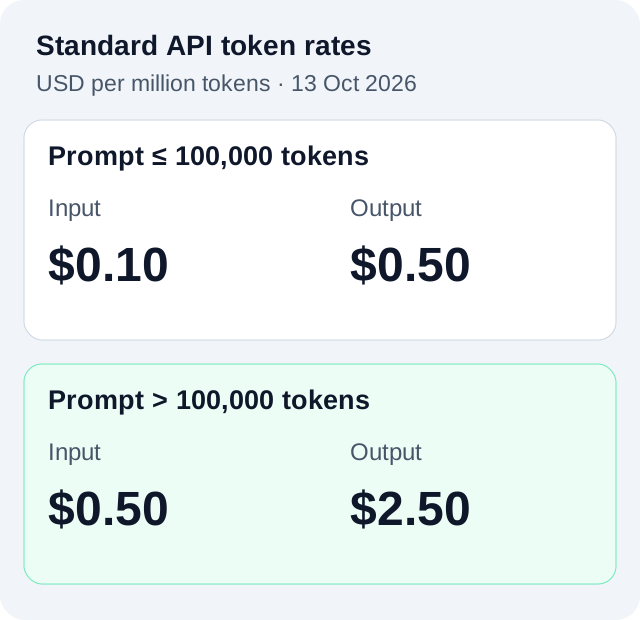
The diagram shows standard Claude API token prices in US dollars. Anthropic's pricing documentation makes the boundary especially important: once the total prompt exceeds 100,000 tokens, the higher tier applies to the whole request, including its output. It is not a surcharge limited to the extra input tokens. Cache reads and cache writes count toward that prompt total, and each request is priced independently.
These base rates are not a complete application budget. Our examples exclude caching unless specified, batch discounts, tool charges, regional modifiers, taxes, retries and infrastructure. Check the billing terms for your actual platform and inference geography before using the estimates in a forecast.
Three API cost examples, including the boundary case
A short extraction request with 20,000 input tokens and 1,000 billable output tokens costs $0.002 in input plus $0.0005 in output: $0.0025 total. At exactly that usage, 10,000 requests would cost $25 in model tokens. This is a calculation for a fixed request shape, not a promise that every extraction task will fit those counts.
At the lower tier's upper boundary, 100,000 input tokens and 2,000 output tokens cost $0.010 + $0.001 = $0.011. Add a single input token, keeping output constant, and the calculation becomes 100,001 × $0.50 / 1,000,000 plus 2,000 × $2.50 / 1,000,000: $0.0550005. That is approximately five times the cost of the preceding request.
For capacity planning, group requests by prompt length instead of relying on one average. A small number of long conversations can have different economics from a much larger set of short tickets. Record the number of requests close to the boundary, then investigate whether their extra context contains evidence the task actually needs. Do not remove useful evidence solely to hit a token target.
Features, context limits and changes from Haiku 4.5
The model overview lists a one-million-token context window, a standard maximum output of 128,000 tokens, and text and image inputs with text output. The Claude API identifier is claude-haiku-5-5. Adaptive thinking is enabled by default, with medium effort as the default setting. Context capacity and economical prompt size are separate decisions: a supported request can still fall into the more expensive tier.
Haiku 5.5 also uses a newer tokenizer. Anthropic estimates approximately 30% more tokens for the same text than Haiku 4.5, with the actual change depending on the content. Recount representative prompts instead of applying an old model's token totals to the new rate card. Include image-heavy requests in that comparison, since a text-only sample can miss a meaningful part of your application's workload.
When prompt caching changes the calculation
Repeated policy documents or stable tool instructions may benefit from prompt caching. At the lower tier, Haiku 5.5 charges $0.125 per million tokens for a five-minute cache write and $0.01 for a cache read. The corresponding one-hour write rate is $0.20. Cache reuse depends on a matching prefix; changing that material can turn an expected hit into a write.
Consider an illustrative request containing an 80,000-token stable prefix, 5,000 new input tokens and 1,000 output tokens. A successful cache hit costs $0.0008 for the prefix, $0.0005 for new input and $0.0005 for output: $0.0018. The first request, writing that prefix into the five-minute cache, costs $0.010 + $0.0005 + $0.0005 = $0.011.
One write followed by nine valid hits therefore costs $0.0272. Ten equivalent uncached requests cost $0.09. Those totals assume identical prefix reuse within the cache lifetime and constant token counts. Measure actual hit rates before extrapolating to a month: a document that changes on every request, or requests arriving after expiry, will produce a different result.
Choose effort settings around a measurable task
Anthropic's Haiku 5.5 prompting guide describes an effort tradeoff: low effort can reduce latency and token use but may skip verification or finish too early. Higher effort can improve instruction-following on harder work while increasing processing. Define what completion means and explicitly request any necessary verification, rather than assuming a longer response is more reliable.
For an initial experiment, compare low and medium effort on the same labelled extraction set. Require the same fields, preserve the same source documents and score both settings against the same expected answers. Escalate only the failed task categories into a second experiment. This makes it possible to distinguish an effort problem from missing context, a weak instruction or a task that needs a different model.
A practical use case: support-ticket triage
A useful pilot is a support queue where each ticket needs a category, an urgency label and the relevant order reference. The model can propose those fields, while ordinary application code verifies that the category is allowed and checks whether the order exists. A missing order reference should produce an explicit missing-information result instead of a guessed identifier.
Build the test set around decisions that are easy to confuse: a refund request versus a delivery complaint, a billing question containing an old order number, and a message with no actionable request. Keep the expected label and its justification beside each example. Review errors by category so a good overall score cannot hide systematic misrouting of urgent tickets.
If the workflow later drafts replies, treat that as a separate capability with its own acceptance criteria. Looking up an order does not require permission to refund it. Our guide to separating read, draft and send permissions explains how to keep those operations distinct when connecting an assistant to real business tools.
What the launch benchmarks can and cannot tell you
Anthropic reports a 39.2% score for Haiku 5.5 on Terminal-Bench 4.0, compared with 70.6% for Sonnet 5.5, in the evaluation table accompanying its launch. These are vendor-reported results under the stated evaluation setup, not an independent test by Daphnis Labs. They provide a reason to investigate capability differences; they do not predict the success rate of your support queue or codebase.
The broader decision should use cost per accepted result. Anthropic's cost and intelligence guide recommends considering task difficulty and completion costs across models. For your comparison, include the second attempt, any escalation and the time a reviewer spends repairing the output. A cheaper first call can become the more expensive workflow when failures require substantial manual work.
Migration checklist for existing Claude integrations
Changing the model name alone is not a complete migration. The Haiku 5.5 migration guide identifies request and response differences to check. Replace legacy thinking configurations that use budget_tokens with the supported adaptive-thinking configuration and effort control. Omit sampling parameters such as temperature, top_p and top_k unless the documented compatibility rules specifically permit your values.
Remove assistant-message prefilling. In response handling, select blocks by their type rather than assuming content[0] contains the final text. Preserve the required thinking blocks when continuing tool conversations, and check for responses where the available output budget is consumed before a usable answer appears. Recount tokens with the new model and verify feature support on your chosen provider; platform integrations do not necessarily expose identical capabilities.
Before rollout, replay sanitized request fixtures against the integration boundary. Check that your application handles invalid requests, refusals, incomplete responses and tool errors without showing a successful completion state. Keep the previous model configuration available for rollback while you investigate failures.
A rollout plan that produces a useful decision
Start with a fixed sample from the work you intend to move. Include typical inputs, the longest valid inputs, contradictory source documents and cases where the correct answer is to request more information. Reserve part of the sample for a final check after prompt changes; repeatedly tuning against every example can make the evaluation look better than the next day's traffic.
For each run, retain the model identifier, effort setting, prompt version, token usage, cache outcome, latency and accepted-or-rejected result. Separate first-response latency from total completion time when tools are involved. Compare tail latency as well as the median, because a small group of slow requests may determine whether an interactive feature feels dependable.
Agree on release criteria before examining results. For ticket triage, these could include no invented order identifiers, a reviewed limit on urgent-ticket misclassification, and a fallback path for missing evidence. Choose thresholds based on the business consequence of each error. Model-generated confidence alone should not decide whether an action is safe to execute.
Then run a limited pilot with review and a clear rollback trigger. Bring the labelled examples, current cost breakdown and known failure cases to an AI evaluation and guardrails review. Those artifacts make the next decision concrete: adjust the prompt, change the effort setting, narrow the task or keep the existing model for the cases Haiku does not handle reliably.