

Inception announced Mercury 3 on 19 October 2026, with access through its own API and partner platforms. Its diffusion-based generation makes it an interesting candidate for interactive support, where several model calls can sit between a customer's question and a useful answer. The engineering decision is whether it improves that complete journey at an acceptable error rate.
Inception's launch measurements report 1,068 tokens per second on NVIDIA GPUs. That is a vendor measurement, not a Daphnis benchmark or a response-time guarantee. We checked the public documentation on 23 October; we have not run Mercury 3. The support fixture, timing diagram, costs and evaluation thresholds below are proposed experiments and illustrative calculations.
Start with a return request that requires evidence
Use a fictional store and ask: can I return order R-104, which arrived nine days ago? The authenticated order record says delivery was on 14 October and the item was marked final sale. The supplied store policy permits ordinary returns within fourteen days of delivery but excludes final-sale items. On 23 October, the expected response should explain the exclusion and offer staff review without promising a refund. This is a synthetic policy for testing, not advice about a merchant's legal obligations.
Give the agent read-only order lookup and policy retrieval. The correct result depends on matching the authenticated customer, finding the item flag and applying the relevant policy revision. A friendly answer based only on the nine-day interval fails. So does a correct explanation that silently initiates a refund. Keep the expected answer and permitted actions in a reviewer sheet outside the model's context.
This fixture reflects a real integration boundary. Daphnis's WOOUM Shopify case study documents a branded returns page that retains Shopify-managed policy content, alongside product, variant and cart integrations. It supports the need to preserve authoritative commerce data. WOOUM is not represented as using Mercury, and the fictional order is not a client incident.
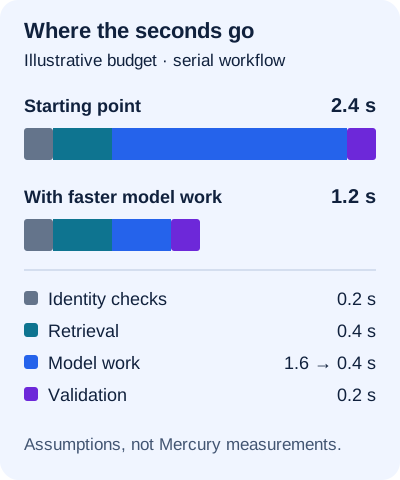
Measure from receipt of the customer's message to the first policy-grounded answer the interface can actually show. The diagram assumes a serial workflow and changes only model time. Its lesson is a budgeting constraint: identity checks, retrieval and validation remain on the critical path. Instrument those stages before attributing an application's delay to its language model.
Check the API contract and migration defaults
The model reference identifies mercury-3 on v1/chat/completions, with a 1M-token context and a 131,072-token maximum output. It supports text, tool calling and structured outputs. These are separate ceilings; leave space for generated output and tool results instead of treating the full context allowance as an input target. For the return fixture, send the relevant order fields and policy passages rather than the entire catalogue.
Mercury 3 is publicly available through the Inception API, and Vercel's gateway listing offers a partner route. The checked launch material does not establish a universal GA service commitment across providers. Confirm account access, region, retention, rate limits and support terms for the endpoint you intend to use. A model listing is not a reservation of production capacity.
Set reasoning effort explicitly. Inception's reasoning guide accepts instant, low, medium and high; Mercury 3 defaults to low, whereas Mercury 2 and 2.5 default to medium. An unchanged request can therefore change its effective setting after migration. Test low and medium as separate configurations, and record the selected value with every trial instead of comparing unnamed defaults.
There is also a migration deadline. The current models page says Mercury 2 and 2.5 are closed to new users, while customers with usage before 19 October retain access until 15 November 2026; enterprise agreements have separate support terms. Existing users should inventory dependent jobs and establish a fallback before that date. Do not assume an old-model rollback remains available indefinitely.
Price the complete queue at launch and regular rates
Inception's published rate card shows launch prices of $0.10 per million input tokens, $0.01 per million cached input tokens and $0.35 per million output tokens. The corresponding regular rates are $0.20, $0.02 and $0.70. The checked pages do not state when the promotion ends. Keep both budgets visible, and use your contracted provider's rates when they differ.
Suppose 10,000 support conversations each consume 8,000 input tokens and 600 billable output tokens across all model calls. That gives 80 million input and 6 million output tokens. With no cache hits, the launch subtotal is 80 × $0.10 plus 6 × $0.35, or $10.10. At regular rates it is $20.20. These assumed volumes include the whole conversation, not just its final reply; retries would increase them.
Now suppose recorded cache hits cover 60 million of those input tokens. At launch rates, 20 million uncached tokens cost $2.00, cached tokens cost $0.60, and output costs $2.10: a $4.70 subtotal. At regular rates the same usage costs $9.40. Repeated policy text does not itself prove a billable cache hit. Reconcile the provider's usage records before treating this scenario as savings.
Token spend may be the smallest line. If an assumed 15% of conversations need three minutes of staff review at $20 per hour, review costs $1,500. Add that to the uncached launch subtotal and the illustrative cost is $1,510.10, or about $0.151 per conversation. Hosting, retrieval, observability, taxes and any speech services remain excluded. This is a sensitivity calculation, not a claim about Mercury's escalation rate.
Track resolved cases as well as total conversations. A model that lowers token spend while generating more ambiguous policy decisions can increase staff work. Conversely, a deliberate escalation may be the correct outcome for a missing delivery record. Classify those cases before comparing costs, so the team does not reward an agent for confidently closing questions it could not answer.
Handle streaming without exposing unfinished conclusions
Inception's streaming documentation distinguishes ordinary streaming, which emits refined text blocks, from the optional diffusing mode, whose events contain full intermediate text snapshots. A client that appends every snapshot can duplicate text. A renderer written for one-token-at-a-time updates also needs checking against block arrivals, cancellation and completion events.
For the support pilot, keep the diffusion visualization out of the customer-facing answer. Show a truthful lookup state while tools run, then expose policy conclusions when the application has validated them. Do not announce that a return is approved while the item flag is still unresolved. A changing animation is not the same as useful progress, particularly for someone reading with assistive technology.
Record three timestamps separately: first received content, first answer safe to show, and completed answer. A quick greeting can improve the first metric without advancing the customer's task. If the interface uses speech, measure the first grounded spoken answer too; speech synthesis and playback add their own delay. Our Voxtral transcription evaluation covers the separate problem of preserving customer intent when audio becomes text.
Run a repeatable support-agent evaluation
Build forty synthetic cases: ten ordinary eligible returns, ten policy exclusions, ten missing or conflicting records, and ten access or tool-failure cases. Include R-104, an order belonging to another customer, an outdated policy passage, a lookup timeout and a customer who corrects the order number. Write the required facts, allowable answer and permitted tool calls before running any configuration.
Compare the current system with Mercury 3 at low and medium effort. Hold the fixture revision, prompts, retrieval results, tool permissions and maximum work budget fixed. Run every case twice per configuration in randomized order: forty cases × three configurations × two repetitions gives 240 trials. Keep additional cases for a later confirmation run rather than repeatedly tuning against the entire test set.
Capture a trace for each attempt: model and provider, configuration, tool arguments, returned records, timestamps, billable usage and final answer. Count retries and failed requests. Ask a reviewer to score policy accuracy, source fidelity, unnecessary escalation and unauthorized actions without seeing the model label. Save both the original response and any correction; replacing an incorrect answer with a polished human edit hides the failure.
Report median and 95th-percentile time to a usable answer alongside quality counts. With eighty attempts per configuration, the tail estimate is exploratory and sensitive to a few slow cases. Repeat at the concurrency expected during a busy support period, checking queueing and throttling separately. Single-request generation speed cannot establish how a full queue behaves.
For an illustrative pilot gate, require zero cross-customer disclosures or unauthorized writes and at least 95% correct policy decisions, then inspect every error. Those are proposed local criteria, not a certification or a prediction. Keep policy-exclusion and missing-record results visible separately: a passing average can conceal a failure concentrated in the cases where the assistant should defer.
The AI evaluation and guardrails service can turn the fixture manifest, scoring rubric and traces into repeatable release checks. For connecting the assistant to order systems, an AI integrations engagement should define authenticated lookup, minimum returned fields, timeouts and reconciliation ownership. The model should receive evidence through those boundaries rather than choose its own customer identity.
Use the failures to choose the next change
If retrieval dominates response time, improving model throughput will have limited effect. If exclusions are repeatedly missed, inspect the retrieved policy and decision rubric before buying more capacity. If medium effort improves accuracy but exceeds the latency budget, test whether only the difficult cases need that setting. Keep the routing rule explicit and evaluate its mistakes as well as the models it selects.
Begin with staff-reviewed drafts and read-only tools. The read, draft and send permission pattern explains how a useful assistant can prepare work while release authority stays with the application. Bring a redacted case set, current response-time traces and the intended provider terms to the implementation brief. Those artifacts make the next decision testable: change the model, repair the integration or retain the existing system.