
Gemini 4 Argon's broader rollout on 13 October 2026 gives application teams a new model to evaluate for substantial, multi-step work. Google's Cloud announcement confirms access through its API and AI Studio. That follows the 30 September introduction, when access initially focused on trusted cybersecurity defenders. An announcement date and a usable deployment route are different milestones.
For an existing application, the useful question is what must change around the model: account eligibility, request budgets, caching, timeouts and acceptance tests. This guide checks primary documentation as of 15 October. We have not run Argon benchmarks or a customer pilot. The calculations and evaluation below are illustrative, and Google's performance statements remain vendor claims.
Check access for the product you actually intend to use
The Gemini app release notes announce a global rollout to Google AI Pro and Ultra subscribers on 13 October. The Antigravity announcement specifies Ultra subscribers for its desktop app and CLI, plus eligible enterprise subscriptions. Meanwhile, the API pricing page explicitly excludes the Free tier and Google AI Pro plan. App access should therefore not be treated as proof of API entitlement or Antigravity access.
The API model reference lists gemini-4-argon as a stable model. It accepts text, images, video, audio and PDFs, and produces text. Computer use is separately marked Preview; image generation, audio generation and the Live API are unsupported. Use these precise statuses instead of assuming that every surrounding tool is generally available because the model identifier is stable.
Before scheduling a migration, have the intended project owner verify access in the actual account and region, confirm billing, and record the endpoint and model identifier. A successful manual experiment in a consumer app does not exercise your application's credentials, traffic limits or error handling. Keep a small access smoke test separate from the quality evaluation so a provisioning failure does not get misclassified as poor model performance.
Treat the million-token window as one shared budget
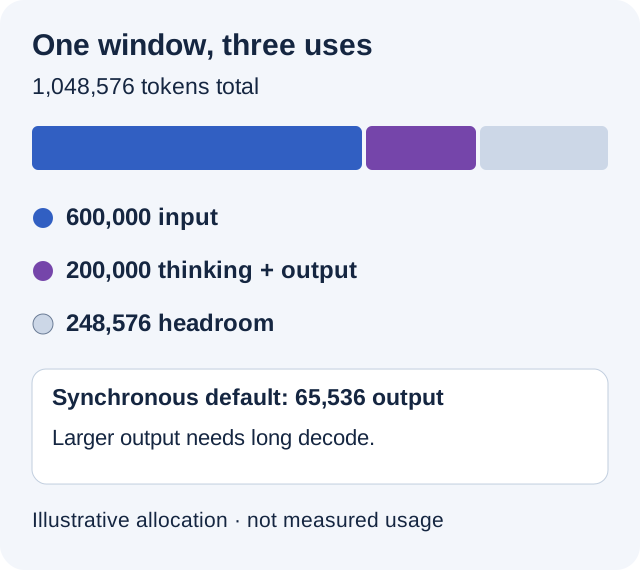
Google's model specifications give a unified context window of 1,048,576 tokens and a default synchronous output maximum of 65,536. The developer guide clarifies that input, thinking and output share that window. Long decode can extend output beyond the synchronous default, subject to the remaining capacity. A million tokens of input and a million tokens of output are not two independent allowances.
The illustrated allocation is not a recommended request size or a measured reasoning requirement. Count the complete assembled request, including instructions and tool context, before deciding how much room remains for completion. Reserve space for follow-up tool results when the workflow needs them; a document upload is only one part of the eventual conversation.
For a document workflow, begin with the smallest evidence bundle that answers the task. Separate a source document's authority from its length: an outdated price sheet does not become useful because it fits. Record document versions and the user's permitted evidence set. The same access-boundary reasoning described in our RAG permissions guide applies when the model can accept much more context.
Budget for thinking tokens and the December price change
The standard API price table lists US-dollar rates per million tokens of $2 input, $0.10 cached input and $10 output, including thinking, through 30 November 2026. From 1 December those rates become $4, $0.20 and $20. These are standard inference prices; other processing modes and tools have their own charges. Do not carry an introductory rate into an annual forecast without a second calculation.
For an illustrative 1,000 requests, assume each uses 80,000 uncached input tokens and 8,000 total billed output tokens, including thinking. At introductory rates, input costs $160 and output costs $80: $240 overall. Holding volumes fixed after 1 December produces $480. This excludes tools, retries, taxes, storage and application infrastructure; it is arithmetic, not a quote or a measured workload.
In a pilot, capture actual usage alongside each accepted and rejected answer. A low invoice is unhelpful if reviewers spend longer repairing the output. Track reviewer minutes and cost per accepted record as separate measures. Keep failures in the denominator, and report how often a retry was needed. That makes it possible to distinguish a genuinely economical configuration from one that merely returns shorter, incomplete answers.
Update the adapter before comparing model quality
Google's migration checklist specifies low, medium and high thinking levels, with medium as default. Explicit context caching is unsupported; implicit caching starts with eligible prompts of at least 4,096 tokens. Temperature, top_p and top_k are ignored. Longer outputs require background execution and an increased output limit; the guide also recommends longer client timeouts for difficult prompts.
Audit the adapter that constructs requests, rather than changing only a model string. Identify which existing options still have an effect, which must be removed and which need application defaults. If an experiment previously varied temperature, relabelling those runs as distinct Argon configurations would create a misleading comparison. Version the effective configuration and preserve it with the results.
For AI integrations and APIs, the integration contract should define required output fields, permitted tools and explicit failure responses. Test malformed output and missing evidence before testing fluent prose. An adapter should reject an unusable response predictably instead of quietly filling missing fields. Keep provider-specific settings behind that boundary so the product's business rules do not depend on one model's configuration names.
Give long-running work a visible job lifecycle
An application that normally answers immediately needs a deliberate experience for work that outlasts a browser request. Our recommended design is a durable job record with queued, running, completed and failed states. Give the user a stable job link, show the last meaningful progress update and explain how they will retrieve the result. Do not imply a completion time that has not been measured.
A client disconnection should not automatically create a second expensive job. Store the provider interaction identifier against your own request identifier and check the existing record before resubmission. Distinguish a failure to retrieve status from a confirmed failure of the underlying work. Our webhook retry guide explains the related duplicate-operation problem; apply the same discipline to actions downstream of an AI response.
Separate generation from publication or database updates. A completed analysis can produce a reviewable draft while its proposed changes remain uncommitted. If a job times out, retain the evidence and diagnostic state needed to investigate it. This makes recovery an operational decision rather than another prompt asking the model to guess what happened earlier.
A practical evaluation: normalize a supplier catalogue
Consider a proposed pilot that converts authorized supplier material into draft catalogue records. Daphnis's Sinzo case study provides relevant workflow context: translating descriptions, removing duplicates and mapping supplier categories. It identifies OpenAI APIs in that project's stack and notes that further commerce development is paused. It is not evidence of an Argon deployment or of results from the evaluation proposed here.
First, assemble a fixed set of 60 permitted examples: 20 straightforward records, 20 with inconsistent units or categories, and 20 with missing or conflicting information. These counts are a suggested starting point, not a statistically sufficient benchmark. Include multiple suppliers and document formats, and keep a separate holdout set for the final decision. Establish reference answers before looking at model output.
Second, define the output contract. Each record should carry a source identifier, normalized title, category, unit, extracted price and a reference to the supporting source location. Specify what to return when a value cannot be established. For example, conflicting pack quantities should trigger review, not an invented conversion. Use deterministic validation for allowed categories, numeric types and required identifiers.
Third, run the incumbent configuration and Argon at each thinking level against the same frozen inputs and instructions. Record latency, billed tokens, schema failures, field corrections and reviewer time. Reviewers should not see which model produced a record while grading it. Repeat a selected subset to observe variability, and distinguish repeatable failures from a single fortunate answer.
Fourth, add boundary cases: a document containing instructions to ignore the task, a source from another tenant, an unavailable attachment and a record whose price contradicts its description. The expected behavior must be written down first. A model should not receive unauthorized documents in the first place; test the retrieval and access layer independently of its ability to refuse an unsafe request.
Finally, inspect failures by category. A wrong unit may need a better schema or deterministic conversion; an unsupported claim may need clearer evidence handling; repeated truncation may indicate an unsuitable output budget. Change one factor at a time and rerun the affected cases. Preserve the original results so improvements are attributable to a specific intervention instead of a moving test set.
Choose rollout gates before choosing a winner
Agree on acceptance rules with the people who will own the workflow. For this illustrative catalogue pilot, a useful starting gate is no unauthorized source exposure and no silent invented prices, followed by a team-defined ceiling for correction time and cost per accepted record. Treat a failure of a critical boundary as a reason to investigate, even if average quality improves. A small passing sample cannot establish that failures are impossible.
Promote the configuration only to the scope the evidence supports. Begin with draft records reviewed by a human, measure performance on fresh inputs and keep a fallback available. A strong result on clean supplier descriptions does not justify unattended changes to stock or pricing. Expanding permissions should require a new evaluation of the resulting action, not just confidence in the text generator.
For a scoped trial, bring a representative input set, the current adapter, expected outputs and the failure cases your reviewers already encounter. Those artifacts let an engineering team estimate the integration work and design a useful comparison. The deliverable should be a reproducible evaluation record and a clear go, revise or stop decision for one workflow.