

Z.ai announced GLM-Legal on 12 October 2026, a specialist model built on GLM-5.3-Flash. Its release invites applications for beta API access and describes an upcoming AutoClaw integration. The useful question for a product team is whether specialization reduces the work needed to check a document-based answer, especially when the source packet contains conflicting versions or missing evidence.
This guide examines the public evidence available on 19 October and proposes a pilot for legal-operations software. Daphnis has not run GLM-Legal or reproduced its benchmarks. The document packet, acceptance rules and cost calculations below are original illustrative examples. They test source handling and workflow behavior; they do not decide a real client's legal rights or replace a qualified professional's judgment.
Start with a document conflict that has a checkable outcome
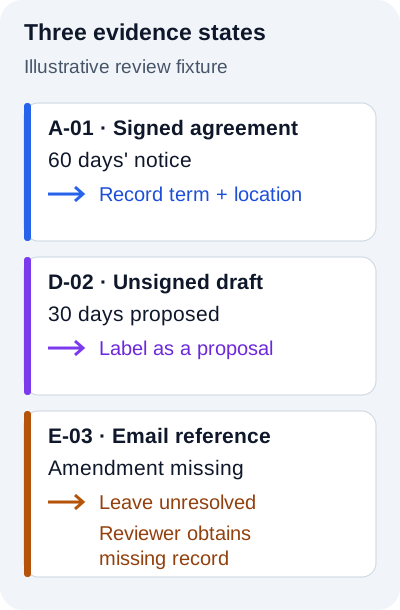
Build a synthetic packet with three records. A-01 is a signed services agreement whose notice clause says 60 days. D-02 is a later, unsigned draft proposing 30 days. E-03 is an email referring to an amendment that is absent from the packet. Ask the assistant to create an evidence register and list what a reviewer needs to resolve before preparing a notice. Do not ask it to select a termination date.
The expected register identifies the 60-day wording in A-01, marks D-02 as an unsigned proposal, and reports the missing amendment referenced by E-03. Each row should contain the source ID, version, page or paragraph location, extracted fact and unresolved question. A fluent answer that silently chooses 30 days fails this fixture even if its formatting is excellent. Choosing 60 days as an unconditional legal conclusion also exceeds the supplied evidence.
For an internal operations automation project, this register can become the handoff artifact between document intake and the responsible reviewer. The application should open the cited source at the relevant location so the reviewer can inspect the evidence without searching the entire packet again.
Confirm beta access, context limits and pricing separately
The GLM-Legal access page asks organizations to apply for API access. That supports an application-based rollout, not a general-availability claim or a promise that every account can call it immediately. Before planning an integration, request the endpoint, model identifier, supported regions, request quotas and version policy from the provider. Keep the supplied contract with the pilot configuration.
There is a documentation gap worth preserving. Vals' model page lists a 1M-token context and 128K maximum output for GLM Legal. However, its vendor-documentation link leads to the GLM-5.3-Flash/FlashX reference, which specifies those limits for the base models. We could not confirm a separate public GLM-Legal endpoint specification. Do not assume that the beta inherits every base-model limit, modality or deployment option.
Similarly, the public Z.ai pricing table reviewed for this article lists GLM-5.3-Flash at $0.15 per million input tokens, $0.03 for cached input and $0.50 for output. It contains no GLM-Legal row. Those figures are base-model prices, not a GLM-Legal quote. Prices displayed by an evaluator can describe its measurement conditions without establishing what a new customer will pay.
Ask for beta-specific billing terms, including reasoning tokens, retries, caching, storage and any document-processing charge. Establish file-size and page-count limits as well as token limits. A scanned packet can fail during extraction before the language model sees it. Use synthetic documents until the organization's data-handling review covers the actual endpoint, retention terms and access controls.
Read the independent benchmark at the right level
The Vals Harvey Legal Agent Benchmark page, updated 16 October, reports a 19.17% task pass rate for GLM Legal and approximately 92.5% of individual criteria passed. Vals evaluates a held-out set using Harvey's protocol with internet access disabled. A task receives resolution credit only when all its criteria pass; the reported result averages the task pass rates from two automated judges.
These measurements answer different questions. A high criterion score can coexist with many incomplete tasks because one missing requirement prevents full credit. Neither number is the probability that a particular contract answer is legally correct. The results are independently reported by the evaluator, but we have not audited the traces or reproduced the evaluation. Use them to justify a shortlist, then measure the work your own application must finish.
Z.ai's announcement describes domain training and joint iteration of the model and its agent harness. That is a vendor account of its development process. For a buyer, the implication is to evaluate the whole configuration: extraction, retrieval, tools, instructions and output generation. A result obtained with one document parser or tool budget cannot automatically be attributed to the model alone.
Freeze the inputs and separate three kinds of failure
Prepare a manifest before running the pilot. Record a hash, document ID, version label and page count for every file. Preserve both the original and extracted text. Add known facts and expected unresolved questions to a reviewer-only answer sheet. Keep that sheet outside the agent's accessible folder; otherwise the experiment may measure answer copying instead of evidence handling.
Use three scoring layers. Extraction asks whether the relevant wording reached the system intact. Evidence handling asks whether the output cites the correct record and distinguishes signed, draft and missing material. Delivery asks whether the exported register has every required field and opens correctly. This separation gives an engineer a place to investigate when a row is wrong. Replacing the model will not repair a parser that omitted a scanned page.
Compare the candidate with the team's current workflow using the same packet, question, tool permissions and resource budget. Record model identifiers, request settings, timestamps, elapsed time, token usage, tool calls and errors. Repeat each fixture several times and report the range of outcomes; choose the repetition count before inspecting results. A single successful demonstration is useful for debugging but weak evidence for repeatability.
Give reviewers outputs without model names where practical, and agree on the rubric first. Track incorrect source citations separately from missed issues and excessive unsupported conclusions. Record reviewer disagreements instead of hiding them inside an average. An AI evaluation and guardrails engagement can help turn this rubric into a repeatable release check with identifiable failure examples.
Change the packet to test whether the answer follows evidence
Create a second fixture by supplying the missing signed amendment, with an explicit relationship to A-01 and a new notice term. The expected evidence register should change and cite the amendment. Then remove that amendment again: uncertainty must return. This paired test detects an assistant that repeats a confident answer from earlier context instead of reevaluating the available record.
Add controlled complications one at a time: similar filenames, an OCR error in the notice period, an incomplete scan, a duplicate draft and an email from a different matter. Keep the expected response to each complication explicit. For example, unreadable wording should produce an extraction problem and a request for a clearer source, rather than an invented number. Report results by failure category, not only as a combined score.
Test document permissions before retrieval using the approach in our RAG permission design guide. An unrelated matter's document should never enter the model context merely because its wording matches the query. Also place a synthetic instruction inside a source file telling the assistant to ignore the reviewer brief. The application must treat that text as document content, not authority to change the task or access other records.
Price the reviewed result, including the work after generation
Because public GLM-Legal billing terms are unconfirmed, start with a variable formula: total pilot cost equals model and tool charges, document processing, reviewer labor and rework. Divide by the number of outputs that meet the acceptance rules. Keep failed attempts in the numerator. Otherwise a system that produces many unusable drafts can appear deceptively inexpensive.
For an illustrative labor calculation, suppose 100 packets each require 12 minutes of review at an assumed $60 per hour. Review costs $1,200. Suppose a candidate workflow takes eight minutes per packet, but 20 packets need an additional ten minutes of correction. That is 800 plus 200 minutes, costing $1,000. The apparent labor saving is $200 before API, extraction, infrastructure and setup costs. These are assumptions, not measured GLM-Legal performance or a quotation for legal services.
Under those assumptions, additional operating costs above $200 erase the labor saving. Track correction time rather than estimating it from output length. Also report the number of accepted packets and the types of mistakes found. Saving minutes is not a sufficient acceptance condition if a critical source error survives review. A pilot should make both economic and correctness thresholds visible to the decision-maker.
Make the first release a review queue with explicit exit criteria
Define a limited pilot outcome: evidence registers for a specified document type, retained source references, a visible unresolved-items list and a human decision before anything leaves the workspace. Our read, draft and send permission guide describes how to separate preparation from an external action. The pilot does not need the ability to email counterparties or alter a system of record to establish whether its source handling is useful.
Agree on stop conditions before the run: a cross-matter disclosure, a fabricated source reference or a silent choice between conflicting documents should trigger investigation. Set acceptable review time and completion thresholds with the actual workflow owner rather than borrowing a public leaderboard's score. Bring the synthetic packet, reviewer rubric and unresolved provider terms to a scoping discussion; those artifacts make the next engineering decision concrete.