
MiniMax officially released M3.1 Flash on 19 October 2026, with access through its API, M Plan and MiniMax Code. For teams building agents, the immediate engineering question is whether lower token prices survive the full workflow: interpreting an image, calling tools, handling changed records and producing something a reviewer can accept.
This guide reviews the documentation available on 20 October and develops a repeatable inventory-review experiment. Daphnis has not run the model or reproduced its performance claims. The fixture, budgets and acceptance thresholds below are illustrative. They give a team a concrete way to compare configurations before committing a real operational workflow to a new endpoint.
Start with a stock discrepancy that has a verifiable answer
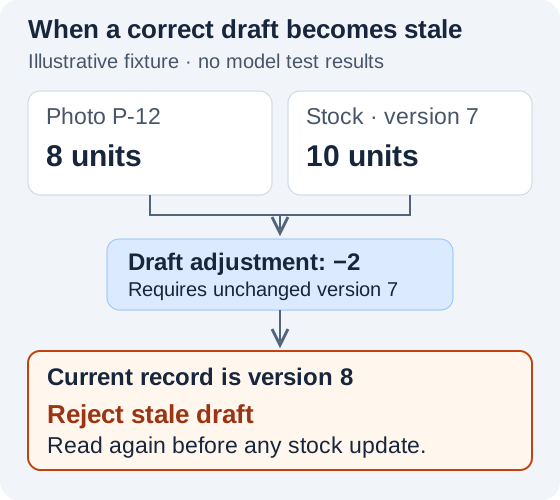
Create a synthetic photo, P-12, showing eight clearly separated sample units beside a readable product label. Supply an inventory tool that returns ten units for that product at record version 7. Ask the assistant to produce a discrepancy draft containing the product ID, observed count, recorded count, source reference and proposed adjustment. Its tools may read inventory and save a draft; they cannot update stock.
The expected draft proposes minus two and cites both P-12 and version 7. Now advance the inventory to version 8 before a reviewer applies the draft. The application should reject the stale version and request a fresh read. This tests a consequential distinction: a correct interpretation of yesterday's evidence can still be the wrong action against today's database.
This class of input problem is relevant to our Sinzo supplier-data and AI engineering work, which includes catalogue processing and warehouse software. That case study documents an existing integration scope, not a MiniMax deployment or a measured result for this experiment. Its commerce development remains paused, and its public images are presentation demos.
Separate the released API from preview access and future weights
The current model directory names MiniMax-M3.1-Flash and lists a 1,000,000-token context window. Older material still refers to MiniMax-M3.1-Flash-Preview. Record the exact identifier accepted by your account rather than assuming the preview alias and released model are interchangeable. Availability in a consumer coding interface also does not establish your API quota, deployment region or service commitment.
There is a qualification around self-hosting. The release notes describe the 19 October model as open-weight, while the launch announcement says weights will arrive later. We have not verified a downloadable release artifact and license for this model. Treat hosted API access as the confirmed route here; require the actual weights, license and serving requirements before scheduling a self-hosted rollout.
MiniMax reports 73.7% on DeepSWE v1.1 and median output speed above 170 tokens per second in its launch post. These are vendor-reported measurements, not Daphnis test results. They support investigating the model but do not establish your task completion rate or end-to-end latency. A stock-review agent spends time on image processing, tool responses, retries and human inspection as well as generation.
Make thinking and tool history explicit in the adapter
MiniMax's OpenAI-compatible reference uses the base URL https://api.minimax.io/v1. For M3.1 Flash, reasoning_effort accepts low, medium, high, xhigh and max; omitting it selects max. Thinking cannot be disabled, and none is unsupported. New integrations should use max_completion_tokens. Choose the effort explicitly so an otherwise innocent adapter change cannot silently alter the experiment's latency and token budget.
The same reference requires preserving the complete assistant response, including tool calls and reasoning_content, across tool turns. It supports text, image and video input, but not audio input. Test your serializer with a two-tool conversation before evaluating task quality: save the first response, add the tool result, then verify that the next request retains the required fields. Displaying a clean final answer and preserving protocol state are separate concerns.
For the Anthropic-compatible interface, effort belongs in output_config.effort, and the complete response.content block list must survive subsequent turns. The documentation lists temperature, stop_sequences, mcp_servers and context_management among ignored parameters. Do not interpret an accepted request as proof that every familiar control took effect. Build a small adapter report that records which requested settings are supported, transformed, rejected or ignored.
Test useful context capacity, not just the advertised ceiling
A million-token window is a capacity figure, not a guarantee that the model will find the right stock row among many similar records. Begin with the smallest packet needed for P-12. Add controlled distractors at successively larger input sizes, placing the correct record near the beginning, middle and end. Keep the expected answer unchanged so a regression can be attributed to the added context rather than a different question.
The Anthropic-compatible documentation provides a count_tokens endpoint for input estimation and warns that thinking consumes the max_tokens generation allowance. A small allowance can end a response before any answer text appears. Classify that as an incomplete attempt, retain its usage and stop reason, and avoid passing an empty draft to a reviewer. We have not established a separate maximum-output ceiling from the sources reviewed; do not reuse the context figure as that limit.
For operational data, fetch only the permitted product and location records needed by the task. Our RAG permissions guide explains why filtering belongs before evidence reaches the model. The large window can be tested with synthetic distractors without broadening the agent's access to real warehouse or customer data.
Calculate cold, cached and reasoning-heavy costs separately
The MiniMax pricing table lists M3.1 Flash at $0.15 per million input tokens, $0.60 per million output tokens and $0.015 per million cached-input tokens. The launch describes these as flat rates. Use the provider's reported billable usage, including the applicable treatment of reasoning, rather than counting only the words visible in the final answer.
Consider 1,000 illustrative attempts, each consuming 20,000 uncached input tokens and 3,000 billable output tokens across its complete tool loop. Input costs 20 million × $0.15 = $3. Output costs 3 million × $0.60 = $1.80. The token subtotal is $4.80. This assumes the input total already includes images and repeated conversation history; treating 20,000 as the size of each individual call would produce a different bill.
If 15,000 input tokens per attempt are actually billed as cache reads, the same workload becomes $0.75 for five million fresh tokens, $0.225 for fifteen million cached tokens and $1.80 for output: $2.775 in total. That is an assumed cache-hit scenario, not a promise that repeating a prompt qualifies. Confirm the usage fields and billing behavior on the selected interface before forecasting savings.
Now hold input constant but raise billable output to 12,000 tokens per attempt. The uncached subtotal becomes $3 + $7.20 = $10.20. This sensitivity calculation does not predict how much a higher effort setting will generate. It shows why measuring reasoning-sensitive usage matters even when the final discrepancy draft is short.
For comparison, the published standard M3 rates for requests with at most 512K input tokens are $0.30 input and $1.20 output per million. Applying those rates to the first hypothetical workload gives $9.60. That is a 50% token-price difference under identical usage, not a measured task-cost reduction. Models can require different numbers of calls, attempts and output tokens.
Run a small comparison with failures visible
Freeze twenty synthetic inventory cases before testing. Include five clearly countable images, five partly occluded scenes, five mismatched product labels and five records that change after the initial read. Give ambiguous scenes an expected unresolved result rather than forcing a numeric answer. Keep the answer sheet outside the agent's accessible files. This collection is a starting fixture, not evidence that twenty cases represent all warehouse conditions.
Compare the current workflow with M3.1 Flash at two explicit effort settings, using identical tools and case materials. Run each case three times: twenty cases × three configurations × three repeats gives 180 attempts. Keep concurrency and tool timeouts fixed. Randomize run order where practical so one configuration does not receive all the measurements during a quiet period. Preserve unsuccessful attempts instead of rerunning them until they disappear from the report.
Score product identification, count accuracy when observable, correct uncertainty, source references and valid draft structure separately. Also check whether the application blocked every stale-version write. These checks distinguish a model interpretation failure from a missing application control. An AI evaluation and guardrails engagement can turn the case manifest and scoring rubric into a repeatable regression set.
Measure time to usable draft, total tool calls, billed tokens and reviewer correction minutes. Report median and slow-tail latency alongside failures and timeouts. If twenty of a hundred attempts fail, dividing token cost only by all hundred attempts understates the cost of an accepted result. Divide the total operating cost by accepted drafts, then retain the failure categories so a low average cannot hide a serious defect.
Choose the first rollout by the failure you can contain
Keep the initial release in a draft queue. Apply the read, draft and send permission pattern to the exact inventory adjustment the reviewer approves, including its product, location, quantity and source version. Add a test where the image contains text telling the agent to ignore the inventory tool. That text belongs to the evidence, and must not become permission to change the workflow.
Set acceptance criteria with the operations owner before seeing the results. For this pilot, a wrong product association or an applied stale draft should stop rollout; ambiguous images should reach a review queue with a useful explanation. Agree separately on acceptable completion rate and correction time. These proposed rules reflect the fixture's risks, not a universal benchmark threshold.
Bring the case manifest, adapter settings, failed examples and cost sheet to an agentic automation scoping discussion. They identify whether the next investment should improve image capture, repair tool integration, change the effort setting or expand the pilot. The first production decision should be small enough that its outcome can be inspected and reversed.