
Moonshot's research index dates Kimi K3.1 Pro to 24 October 2026, while OpenRouter dates its model listing to 23 October. These are different publication milestones. For teams choosing a coding model today, the useful question is whether its larger working context and revised reasoning can complete a change across several files without breaking behavior elsewhere.
The official announcement describes a post-trained successor to K3, available across Kimi's hosted products and API. Full weights are promised by 4 November 2026. Treat that as a future delivery date, not evidence that a self-hostable checkpoint is already downloadable. We reviewed public sources on 24 October; we have not run K3.1 Pro. All fixtures, budgets and acceptance thresholds below are proposed, not measured results.
Give the model a change with consequences across files
Consider a synthetic interactive portfolio with a 3D project scene, an animated timeline and a shared motion preference. The task is to consolidate duplicated preference logic into one module while preserving both the animated experience and its reduced-motion alternative. This tests dependency discovery, cleanup and behavior preservation rather than whether the model can generate an attractive isolated component.
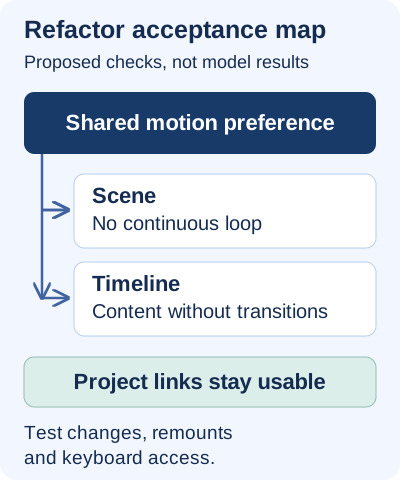
The fixture should require the scene to stop continuous animation when reduced motion is selected, the timeline to show its current content without transitions, and every project link to remain keyboard-operable. Changing the preference during a session must update both components. Navigating away and back must not accumulate subscriptions or create an extra animation loop.
Daphnis's Cane & Clay case study documents an actual Three.js journey with viewport-dependent quality, off-screen render suspension and a reduced-motion text alternative. It supports the relevance of these engineering constraints. The proposed repository is fictional; Cane & Clay is not represented as using Kimi, and no client code or outcome is part of this experiment.
Create a small dependency map before the run: preference source, scene consumer, timeline consumer and navigation behavior. The diagram shows the acceptance contract. Keep the full reviewer checklist outside the agent's writable workspace, while giving the agent a clear task brief and ordinary development tests. Otherwise, an agent could appear to succeed by weakening the very checks meant to judge its patch.
Choose the API or Kimi Code before comparing limits
The metered API pricing documentation specifies a 1,048,576-token context for K3-series models and separates API billing from Kimi membership and Kimi Code. The K3.1 Pro quickstart names kimi-k3.1-pro and kimi-k3.1-pro-highspeed; access requires a successful top-up of at least $1. That is an account prerequisite, not an estimate of a project's cost.
Kimi Code uses different identifiers and entitlements. Its model configuration guide lists k3.1-pro for Plus/Moderato and higher tiers, with the full 1M context reserved for Pro/Allegretto and above; the lower eligible tier has 256K. Highspeed requires the higher tier. A paid coding membership therefore does not automatically mean every client request can use the advertised maximum window.
The same guide describes Highspeed as roughly two to three times faster at generating output, with about twice the coding-plan quota usage. This is a vendor claim, not an end-to-end refactor measurement. Test execution, dependency installation and reviewer time remain separate. Record the product, endpoint, exact model identifier and account entitlement so two trials do not silently compare different services.
The launch material describes a hosted rollout, rather than an invitation-only research preview, but it does not establish one universal GA service commitment for every channel. Enterprise administrators must enable the model; access is off by default at launch, according to the availability section. Confirm the provider's region, retention and capacity terms before using private repository content.
Check the request contract before the first benchmark
The API quickstart's limits make thinking mandatory, with low, high and max effort levels and max as the default. It gives max_completion_tokens a default of 131,072 and a ceiling of 1,048,576. The completion setting and total context are different constraints: reserve room for output and subsequent tool results instead of filling the entire window with source files.
That guide also fixes sampling settings, including temperature 1.0 and top_p 0.95, and requires complete assistant messages to be carried into later tool turns. An adapter that keeps only final text can lose required protocol fields. Test the adapter with a short read-file, inspect-result, answer sequence before paying for a large repository run.
Use one explicit effort setting throughout each trial. Start with the files implicated by the dependency map, then allow controlled search for additional references. A million-token ceiling does not tell you which files are relevant, whether stale documentation conflicts with current code, or whether the model noticed an important cleanup path.
Log the actual request configuration and returned model identifier, alongside the fixture revision. Our Claude Sonnet 5.5 migration evaluation discusses the same need to validate an integration contract before comparing coding results. Keep model-specific adapters separate from the common task and scoring procedure.
Budget the refactor, including cache writes
The official API model cards list standard K3.1 Pro at $2 per million input tokens, $10 per million output tokens, $2 per million cache-write tokens and $0.20 per million cache-hit tokens. Highspeed lists $4, $20, $4 and $0.20 respectively. These are the displayed USD rates on 24 October; coding-plan quota is a different charging system.
For an illustrative standard-model trial, assume 400,000 input tokens and 20,000 billable output tokens across all requests. At the displayed regular input rate, that is 0.4 x $2 plus 0.02 x $10, or $1.00. With the same usage, Highspeed is $2.00. These assumed totals include repeated prompts and tool turns; they are not the repository's file size or a prediction of Kimi's usage.
Now split the standard trial's input into 100,000 default-TTL cache-write tokens, 250,000 cache-hit tokens and 50,000 uncached tokens. Using the displayed write rate gives $0.20 + $0.05 + $0.10 for input, then $0.20 for output: $0.55. The cache accounting guide says these three input buckets are mutually exclusive. Do not charge the write tokens again as ordinary uncached input.
That calculation assumes the default five-minute cache policy and observed hits. The guide also supports a one-hour TTL with its own write pricing; verify that rate before substituting it. A human review pause, changed prefix or expired entry can change the bill. Reconcile reported cache-read and cache-write usage with the invoice instead of estimating hits from repeated-looking text.
Model spend is only one part of the decision. Suppose a reviewer spends twelve minutes on a patch at an assumed $40 per hour: review costs $8. Adding the $1 uncached standard trial produces $9 before execution infrastructure or retries. This is an illustrative staffing assumption. Measure review effort and accepted patches so a cheaper generation does not disguise more repair work.
Run the same refactor under controlled conditions
Prepare twelve variations of the synthetic repository: four straightforward duplicate-hook cases, four with route remounts or delayed scene loading, and four with conflicting legacy helpers or missing cleanup. Preserve a clean baseline for each. Include one case where the correct change is deliberately small, so unnecessary rewrites are visible rather than rewarded as productivity.
Compare the current coding setup with K3.1 Pro at high and max effort. Give each configuration the same brief, file access, dependency versions, tool permissions and time budget. Run each case twice in a fresh checkout, randomizing the order: twelve cases x three configurations x two repetitions gives seventy-two attempts. This small study can expose concrete failure modes; it cannot establish a universal model ranking.
Collect the patch, command history, test output, request usage and elapsed time before a reviewer edits anything. Score functional completion first. Does changing the preference update both consumers? Does the fallback retain project names and links? Do route remounts keep the expected listener count? Instrument the fixture so these questions produce observable evidence.
Then inspect both motion modes at desktop and mobile sizes. Follow keyboard focus through the project links and timeline controls. Check the initial render as well as a preference change after loading. A static screenshot can show layout, but it cannot establish that cleanup occurs or that an animation has stopped scheduling work.
Reject attempts that remove the fallback, disable a relevant test, add unrelated dependencies or modify files outside the agreed scope. Keep those failures separate from compilation errors and timeouts. A patch that passes the happy path by deleting the difficult feature has not completed the refactor.
Have a reviewer assess correctness and maintainability without seeing the model label. Record how many minutes were needed to understand and repair each patch, and retain the original result. Compare accepted changes per dollar and per reviewer hour alongside completion time. Report counts for each failure category; an average score can hide a model that repeatedly mishandles remounts.
An AI evaluation and guardrails engagement can turn this fixture collection into repeatable release checks. When the challenge is preserving an existing animated experience, interactive web development supplies the implementation scope: scene lifecycle, accessible alternatives, responsive behavior and the actual visitor actions that must survive.
Use the results to set a narrow rollout
If high effort passes the same cases as max with less work, expand that configuration to a new held-out set before adopting it. If failures cluster around cleanup, improve the task's lifecycle evidence and retest. If patches are correct but expensive to review, narrow the change boundary or require a concise map of affected files. Each failure should suggest an engineering change, not just another model switch.
Keep the first rollout limited to reviewable patches in isolated branches. Define a stop condition for unauthorized file changes, repeated regressions or budget overruns, and keep the existing workflow available while investigating. Bring the fixture revisions, scoring sheet, unedited patches and actual usage breakdown to the decision. Those artifacts show whether K3.1 Pro helps your repository, without treating a launch benchmark or a larger context window as proof.