

Claude Sonnet 5.5, released on 28 September 2026, deserves a compatibility review before a production model swap. Anthropic's launch announcement reports faster generation and lower task costs than Sonnet 5, positioning the model for everyday coding and knowledge work. Those are vendor findings, not results from a Daphnis benchmark. We have not run hands-on Sonnet 5.5 tests; the calculations and evaluation procedure below are original planning examples.
The announcement lists availability through the Claude Platform, Amazon Web Services, Google Cloud and Microsoft Azure. Anthropic's lifecycle table marks the model Active, while its model reference lists claude-sonnet-5-5, a 1M-token context window and 128K maximum output. It is a released model without a Preview label on that page; individual tools and features can have separate statuses. Verify your account, region and required features on the platform you will deploy.
There is also a concrete migration deadline for some teams. Anthropic announced Sonnet 4.5's deprecation on 30 September, with Claude API retirement scheduled for 30 November 2026 and Sonnet 5.5 recommended as its replacement. That retirement notice makes an adapter inventory useful now, even if a full rollout waits for evaluation.
Separate token prices from the cost of a completed task
The current Claude pricing table lists Sonnet 5.5 at $2 per million input tokens and $10 per million output tokens. Cache reads are $0.10; five-minute cache writes are $2.50 and one-hour writes are $4 per million tokens. These are US-dollar API rates, not a Claude subscription price. Partner-cloud invoices and optional features need their own checks.
Anthropic reports more than 30% faster output generation and up to 30% lower cost per task in its launch testing. Neither percentage is a promised saving for your application. A workflow may spend most of its time waiting for tools, and its bill may be dominated by input rather than output. Record both quantities before forecasting a migration benefit.
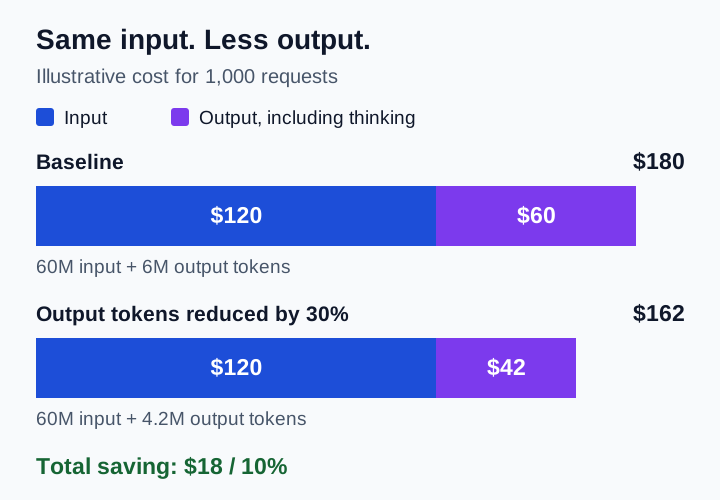
For the illustration below, assume each request starts with 60,000 uncached input tokens and 6,000 billed output tokens, including thinking. Hold input constant and reduce output by an assumed 30%. The chart calculates the resulting bill at the listed rates; it is not a prediction or measured comparison. Cache operations, retries, tools, infrastructure and taxes are excluded. Input dominates this example, so optimizing completion length alone has a limited effect on the total.
Use the same distinction when comparing models. Our Haiku 5.5 pricing guide addresses a different decision: a smaller model's prompt-length price boundary. First establish which configuration completes your task acceptably; then compare its actual usage and review effort. A cheap failed patch still consumes engineering time.
Update the request contract before judging answer quality
The Sonnet 5.5 migration guide says thinking disabled is rejected. To avoid up-front thinking, use between_tools at low, medium or high effort; xhigh and max require adaptive thinking. Read responses by block type instead of assuming the first block contains text. The output limit includes thinking and text, so an old max_tokens value may need review.
The same guide identifies forced tool choice, assistant prefill, thinking budgets and non-default sampling parameters as migration concerns. The changes required depend on the starting model and platform. Treat the provider's checklist as an inventory: mark each setting present, absent or delegated to an SDK, and attach the affected application path. This is more reliable than checking only the function that contains the model name.
Our proposed first test is deliberately small. Send a synthetic request through the real adapter, capture the response types and stop reason, and verify that the application handles text, tool calls and errors separately. Then exercise a tool-result round trip. A compatibility failure should produce a clear diagnostic rather than an empty answer that gets scored as a model-quality failure. Include these contracts in an AI integration engagement.
Check progress displays too. The model reference explains that text between tool calls now arrives in thinking blocks. An interface that listens only for text can appear idle. Decide what user-facing progress your product needs and use the documented display options; do not present missing progress events as proof that the underlying job has stopped.
Test saved conversations as carefully as new requests
Anthropic's preserved-thinking documentation ties Sonnet 5.5 thinking blocks to the producing account or a linked account. It also checks the system prompt, tools and messages preceding a retained thinking block. Editing that prefix can invalidate later blocks; enforcement and available controls depend on account history and configuration. A successful fresh conversation does not validate your saved-session path.
Build a separate integration fixture around the operations your product actually supports: save, restart, resume, change instructions and switch models. Compare the serialized history before and after each operation. If your application reconstructs earlier messages from changing templates, identify that transformation explicitly. Record whether the API rejects the request or continues after dropping blocks, rather than reducing both events to a generic retry count.
For a coding assistant, also separate conversation continuity from repository authority. A remembered instruction does not grant access to another tenant's files or permission to merge a patch. Supply the permitted checkout and tools for each task. Our read, draft and send permissions guide describes how to keep reviewable output separate from the action that publishes or applies it.
Use a merchant-sorting bug as a concrete coding fixture
A useful coding evaluation needs an observable business rule. Imagine a merchant tool that sorts products by score, keeps eligible pinned products first and excludes unavailable items. The reported bug is that equal scores produce a different order after refresh. Ask the candidate model to make the ordering deterministic without changing pinning or stock eligibility. This is a hypothetical exercise, not a defect reported in a client application.
The domain has a relevant Daphnis example: PA: Product & Collection Sort combines Shopify app development with RFM algorithms and AI for merchandising. Its case study documents a self-hosted MegaBeam-Mistral-7B deployment. That supports the product context; it provides no evidence of Sonnet 5.5 use or performance. A migration evaluation must establish those results separately.
Create a synthetic catalogue with two eligible pinned items, two unpinned items sharing a score, one unavailable item and one item belonging to a different store. Specify a stable product identifier as the tie-breaker, and define whether identifiers sort numerically or lexically. Write the expected order before running the model. Repeat the same request with the input array shuffled, and verify that the output order remains identical.
Give the model the relevant sorting function, its callers, an API contract and the failing test. Restrict edits to the sorting implementation and associated tests. Keep additional acceptance cases hidden from the prompt: no pinned products, all products unavailable, missing scores and another tenant's identifier. These cases distinguish a general fix from a patch that memorizes the example. A reviewer should inspect any changed test that makes a failure disappear by weakening the assertion.
Preserve the actual patch, test output and scope decision. Passing the named regression is necessary but insufficient if the solution also changes the API shape or removes stock checks. Score those as separate failures. This creates a reviewable record for AI evaluation and guardrails, with concrete acceptance evidence instead of a single subjective judgment about how convincing the explanation sounded.
Compare effort settings with a fixed acceptance rule
Start with the current production configuration as a baseline and a small set of explicitly configured Sonnet 5.5 candidates. Do not compare a familiar app default with an unspecified API default: Anthropic documents medium effort in its apps and Claude Code, but high on the Claude Platform. Record the effective settings alongside every run, including the SDK version and tool permissions.
For an initial screening exercise, repeat each candidate on five independently reset copies of the same fixture. Five runs can expose variability; they cannot establish broad production reliability. Keep the repository revision, dependency versions, time budget and available tools fixed. Randomize review order and hide the configuration label from reviewers where practical. Follow up on a broader set of representative tasks before drawing a rollout conclusion.
Measure accepted patches, failed acceptance cases, out-of-scope edits, total API spend and reviewer minutes. Include all failed attempts in the cost numerator. Divide total evaluation spend by accepted patches only when there is at least one; otherwise report no accepted result. Keep time to first visible progress separate from end-to-end completion time, and record external tool waits so they do not get mistaken for model latency.
Agree on the decision rule in advance. For example, preserving tenant and stock boundaries can be mandatory, while a slightly longer runtime may be acceptable within the team's existing limit. If higher effort fixes one task but adds unrelated edits on another, inspect that trade-off rather than declaring the larger setting universally better.
Make the rollout reversible and the next decision explicit
After compatibility and fixture checks pass, begin with a limited cohort that produces reviewable patches. Keep the existing provider route available, and record which version served each task. Define which failures stop expansion: invalid requests, unacceptable edits, permission violations or a cost increase beyond the agreed budget. A fallback must preserve the application's approval rules instead of silently granting a second model broader tools.
Bring the adapter inventory, one representative task, the acceptance cases and the measured review burden to a Loop Engineering discussion. Those artifacts give the team enough detail to choose the next experiment: repair the integration, change the prompt, adjust effort or retain the current model for that workload. Recheck prices and provider documentation before a later rollout; this source review is dated 16 October 2026.