
DeepSeek released V4.1-Flash-1017 on 17 October 2026, updating its API, website and app. The API still accepts deepseek-flash, with unchanged model rates. The same release opens Search and Fetch APIs. For an engineering team, the immediate question is whether an existing agent now completes a useful task with fewer errors, less elapsed time or a lower total bill.
DeepSeek reports improved benchmarks and shorter task execution in its release announcement. Those are vendor claims. We have not tested this model or reproduced its results. This guide uses an original evaluation design and illustrative arithmetic, with specifications checked on 18 October 2026. It focuses on a common failure: an agent produces plausible code using documentation for the wrong API version.
Give the agent a versioned question with a checkable answer
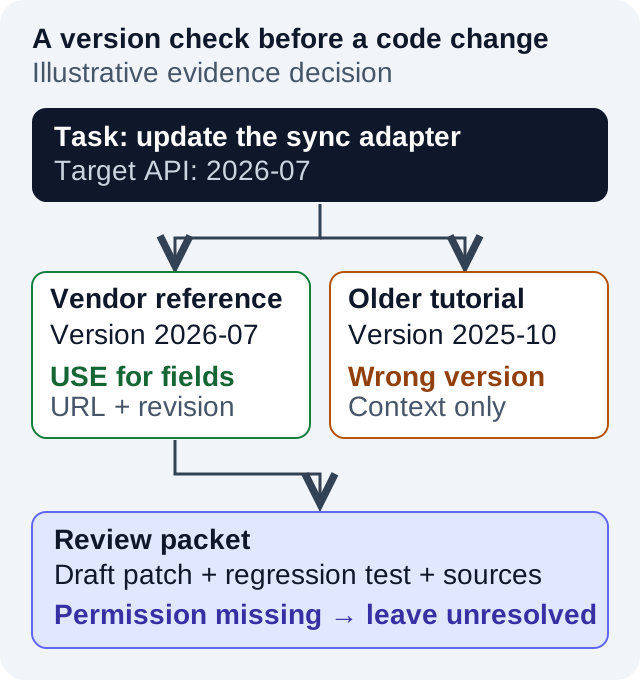
Consider a fictional merchant application whose developer asks: update the collection-sync adapter for API version 2026-07, identify the required permission, and draft the corresponding test. This is a constructed task, not a claim about an actual vendor release. Provide the current adapter, a small synthetic response fixture and the exact target version. Keep production credentials and merchant records out of the exercise.
An acceptable result has three artifacts: a proposed patch, a test that fails against the old behavior, and an evidence packet connecting each compatibility claim to a source revision. Suppose retrieval finds a current vendor reference and a convincing tutorial for an older version. The tutorial may explain the general concept, but it cannot establish the requested version's field names. If neither source establishes the permission, the answer should leave that requirement unresolved.
This is the boundary worth measuring. A patch that compiles can still encode the wrong contract. In an AI API integration project, make the source version and acceptance fixture part of the task definition, so reviewers can distinguish a supported change from a fluent guess.
Check the deployed model, context limits and hosting path
The current API specification maps deepseek-flash to DeepSeek-V4.1-Flash-1017 and lists a 1M-token context, a maximum 384K-token output, vision and tool calls. These are limits, not a reason to send an entire repository. Select the adapter, its callers and relevant documentation first; record what was omitted so a failure can be investigated.
The release is presented as available on the API, web and app, without a preview label for 1017. That does not establish a separate enterprise SLA. The changelog also says the older deepseek-v4-flash and deepseek-v4-flash-vision-exp names route to the replacement model. A stable request string therefore does not pin behavior. Save the request date, returned model information and harness version with each evaluation.
For self-hosting, the official 1017 model card publishes MIT-licensed weights and a reference prompt encoder, but no Jinja-format chat template. Its protocol toolkit leaves inference, tool execution and HTTP transport to the caller. Treat prompt formatting and tool-result parsing as integration work. Downloadable weights do not make a local deployment operationally equivalent to the hosted API.
Avoid mixing hosting decisions into the first quality comparison. If one candidate uses different retrieval, more tool permissions and a larger task budget, the result describes two systems, not just two models. Record those differences explicitly when a system-level comparison is the decision you actually need.
Calculate token cost before adding search
At the checked USD rates, one million Flash input tokens cost $0.003 off-peak or $0.006 peak when cached, and $0.15 or $0.30 when uncached. Output costs $0.60 or $1.20 per million. Peak windows are 01:00–04:00 and 06:00–10:00 UTC on weekdays, excluding Chinese public holidays; other times are off-peak. In India those windows are 06:30–09:30 and 11:30–15:30 IST.
Here is an illustrative budget for 100 investigations. Assume each consumes 20,000 uncached input tokens and 4,000 billed output tokens in total across all its turns. Aggregate usage is 2 million input and 0.4 million output tokens. Off-peak cost is (2 × $0.15) + (0.4 × $0.60) = $0.54. At peak rates it is $1.08. These assumed token counts are not measured model behavior, and repeated context in later calls must be included.
If 75% of that same input were actually billed as cache hits, the off-peak input calculation would become (1.5 × $0.003) + (0.5 × $0.15) = $0.0795. Adding $0.24 for output gives $0.3195. This is a sensitivity calculation, not a promised cache-hit rate. Use provider usage records rather than estimating hits from repeated words in a prompt.
The useful denominator is accepted work. If the uncached batch cost $0.54 but only 60 investigations met the review rubric, model cost per accepted investigation would be $0.009. Report failed attempts, retries, reviewer time and elapsed time separately. A cheaper individual response can be a more expensive workflow if it creates additional correction rounds.
Treat search as a separate bill and a separate dependency
DeepSeek's Search & Fetch guide describes separate JSON endpoints: POST /v1/tools/search and POST /v1/tools/fetch. Each costs $0.75 per 1,000 successful requests. A search must return nonempty results, or a fetch must return content, to be billable; failed requests, empty searches and timeouts are not billed. Returned result count does not change the request price.
Suppose each of the 100 investigations makes two billable searches and three billable fetches. That is 500 requests, costing $0.375 at the published rate. Combined with the uncached off-peak model example, the total becomes $0.915 before other infrastructure or labor. Search and fetch account for about 41% of this illustrative total. Budgeting only language tokens would miss a material part of this particular workload.
The launch notice separately grants a temporary free period for server-side search/fetch tool calls through DeepSeek Harness, Claude Code and Codex when using the DeepSeek API. Billing begins on 31 October at 16:00 UTC, or 21:30 IST. Do not apply that temporary arrangement to every standalone API call, or assume an October trial predicts November costs.
The guide lists independent account-level limits of five queries per second for Search and five for Fetch, with additional per-domain fetch limits. Use bounded queues and backoff for transient failures. An empty result is a valid retrieval outcome, not evidence that the model should invent the missing fact. The Fetch reference returns a title and Markdown content; retain the requested URL and retrieval timestamp in your own evidence record.
Run a two-pass evaluation that separates reasoning from retrieval
First, assemble 24 small compatibility tasks from work your team can judge. For an initial exploratory set, use eight straightforward changes, eight version conflicts and eight cases with missing information or inaccessible sources. These counts are a proposed design, not a statistically validated sample size. Keep a separate holdout set for the final decision, and define the expected behavior before reading model answers.
Include difficult evidence cases deliberately: a recent blog describing an old API, a current page that omits the permission requirement, an unavailable reference and a page containing instructions unrelated to the user's task. The agent should treat retrieved text as evidence, never as authorization to expose credentials, edit unrelated files or run commands supplied by the page. Enforce tool boundaries in the application, beyond prompt wording.
In pass one, give each candidate the same frozen source packet. Disable live search and allow only the same sandboxed coding tools. Pin the repository revision, prompt, harness, reasoning setting, timeout and retry budget. This isolates how well the candidate interprets evidence and modifies the adapter. Use the team's current production system as the baseline; do not describe a comparison against the previous Flash release unless you can still run that exact version.
In pass two, enable retrieval and repeat the tasks with identical source policies and budgets. Save queries, returned URLs, fetched content hashes, timestamps, tool errors and token usage. Separate failures to find the right document from failures to use a document that was supplied correctly. This distinction tells you whether to change retrieval, the prompt, the model or the acceptance test.
Score each run on contract correctness, regression-test quality, citation support, handling of missing evidence and tool-policy compliance. Check that a cited passage supports the specific claim and target version; a link to the right vendor's homepage earns no credit for an unsupported field name. Review outputs without model labels where practical, and record reviewer disagreements rather than concealing them in one average score.
Repeat a subset to expose variation. Report first-attempt success and eventual success under the fixed retry allowance separately, alongside median and slow-tail completion time. Count timeouts and invalid patches in the denominator. The evaluation and guardrails scope should define release-blocking failures before a cost comparison can influence acceptance. One credential disclosure or unauthorized write must not disappear inside an otherwise favorable mean.
Turn the results into a bounded engineering pilot
The merchant-app setting has a real Daphnis reference: PA: Product & Collection Sort documents a Shopify application with a React interface, Python backend, RFM algorithms and a self-hosted MegaBeam-Mistral-7B model. It supports the integration context, but supplies no evidence of DeepSeek adoption or 1017 performance. Keep the fictional adapter exercise separate from that project's documented work.
Begin with draft patches and evidence packets for engineer review. Our published guide to read, draft and send permissions explains how to assign capabilities at the actual action boundary. The agent's ability to retrieve documentation does not grant permission to publish a merchant change. When private repository knowledge is added, apply the access mapping in our RAG permissions guide before supplying passages to the model.
For the first review, bring one adapter, its target API version, a synthetic response fixture and three examples of documentation ambiguity. Agree on the minimum accepted-task rate, maximum review effort and failure conditions that stop the pilot. That gives the team a decision it can audit when the model behind an alias changes again.