

Mistral released Voxtral 3 on 20 October 2026, introducing speech models and a voice-agent SDK. For an operations team, the useful question is whether the system preserves the details that change a job: a corrected date, a product name, an interrupted instruction or which speaker made a request.
This review uses public documentation checked on 21 October. Daphnis has not called these endpoints or reproduced the vendor's benchmarks. The collection-request fixture and budgets below are illustrative, designed to help a team evaluate transcription before connecting speech to business actions. The first decision is whether you need a transcript after a call or usable text while the caller is still speaking.
Start with a correction that changes the operational result
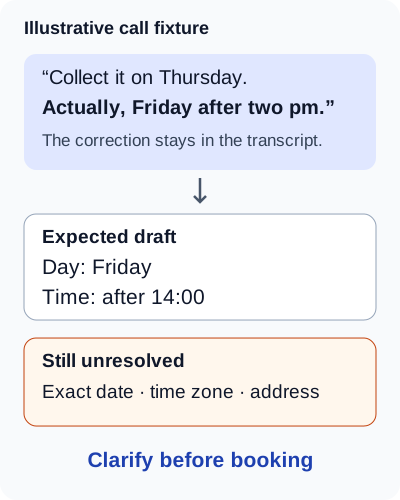
Record a staged furniture-return conversation with consenting participants and fictional details. The caller says, "Collect the chair on Thursday. Actually, Friday after two pm." A second speaker asks which address to use. The recording ends before the caller answers. Keep the reference transcript and expected fields separate from anything supplied to the model.
The expected draft records Friday and a lower time bound of 14:00. It does not invent an exact calendar date, time zone or collection address. Preserve the correction in the transcript even though the structured draft uses the later instruction. A fluent summary that schedules Thursday is a failed result; so is a Friday booking at an address nobody confirmed.
This operational setting connects to Daphnis's Cityfurnish mobile-app and warehouse work, whose documented scope includes dispatch, returns and repairs. It is context for why collection details matter, not evidence of a Voxtral integration. The case study's warehouse screens are explicitly illustrative, and its current app imagery is not verified as the historical delivery version.
Choose a transcription endpoint and preserve its preview status
The dated model cards label all three transcription models Public Preview. Voxtral Mini Transcribe 3, ID voxtral-mini-transcribe-3-0, lists $0.0035 per audio minute. Voxtral Small Transcribe 3, ID voxtral-small-transcribe-3-0, lists $0.004 per minute. Both serve recorded-file transcription. Voxtral Mini Transcribe Realtime 3, ID voxtral-mini-transcribe-realtime-3-0, lists $0.008 per minute for streaming transcription. Availability does not make these generally available production commitments.
Mistral's speech-to-text guide recommends Mini as the initial offline choice and Small when vocabulary adjustments do not resolve remaining errors. It also says audio questions and summaries use Voxtral 2 at launch. That is narrower than Small's broad model-card description. For this pilot, treat transcription and downstream field extraction as separate components, with separate versions and scores.
The language reference lists 50 languages for offline transcription and 45 languages and dialects for realtime. Check the selected model's list before promising a particular language or mixed-language workflow. Mistral announces an EU-hosted API and self-deployment in the launch post; this review does not verify downloadable weights, a self-hosting license or hardware requirements. Confirm those separately if infrastructure ownership drives the decision.
Resolve the context discrepancy before accepting long recordings
There is an unresolved difference in the launch documentation: Mini and Small model cards display 32k context, while the audio limits page states 65,536 tokens shared between audio and context_bias. That page describes an over-limit request as a 400 error rather than silent truncation. The realtime card gives no numeric context ceiling. Do not turn any of these figures into a promised maximum call duration without endpoint-specific confirmation.
Begin with short recordings and retain the request identifier, exact model ID, audio duration and vocabulary size for every attempt. Add progressively longer fixtures only after the small cases work. Test the application's rejection path: the user should see that processing failed, and the job should remain recoverable. An empty transcript must never be interpreted as evidence that a customer made no request.
Migration also changes the evidence your interface can display. The Voxtral 2 migration guide says word timestamps are no longer accepted; request segment timestamps instead. It also calls out overlapping diarization segments and settings that lock when realtime audio begins. A player designed around one highlighted word or one speaker at a time needs an explicit compatibility review before the endpoint changes.
For the collection fixture, a segment-level replay link is enough to let a reviewer hear the correction. Keep the recording offset associated with the relevant transcript segment. If your product requires karaoke-style word highlighting, mark that requirement unresolved rather than manufacturing word timings by dividing the segment duration evenly.
Budget for accepted transcripts, including review time
Use the model-card rates above for a transparent first estimate. Suppose 1,000 recordings average six minutes each, giving 6,000 minutes. Mini transcription costs 6,000 × $0.0035 = $21; Small costs 6,000 × $0.004 = $24. Processing the same duration through Realtime costs 6,000 × $0.008 = $48. These are illustrative transcription subtotals, excluding taxes, retries, storage, telephony, speech generation and any model that extracts fields afterward.
The offline price difference is $3 across that workload. At an assumed reviewer cost of $20 per hour, nine minutes of total review time also costs $3. Spread across 1,000 calls, that is 0.54 seconds per call. This is a sensitivity calculation, not evidence that Small saves time. It shows why a small token or minute-price difference can be outweighed by correction effort.
Track all attempts, including failures and repeated audio. If 10% of the six-minute recordings require one complete retry, Mini processes another 600 minutes and adds $2.10 before review. If only 900 transcripts meet the acceptance rubric, divide the complete workflow cost by those 900 accepted results. Retain the rejection reasons so an apparently cheap average cannot hide systematic failures on names or corrections.
A live conversation may justify its additional cost when text is needed during the call. A nightly quality-review queue may not. Compare each mode against the response time the workflow actually requires, then measure billable usage under the account's current terms. Do not present a transcription-only subtotal as the price of a complete voice agent.
Build a small evaluation that exposes consequential errors
Prepare thirty short staged calls: six clean requests, six date or quantity corrections, six unfamiliar product names, six interruptions or overlapping speakers, and six ambiguous or incomplete requests. Include the collection example in the correction group. This is a practical starter set, not a statistically representative sample of customer calls. Keep a separate held-out group for the final decision so prompt adjustments do not merely memorize the evaluation.
Have two reviewers agree on the transcript and operational answer for each case. Mark uncertainty explicitly: an inaudible number is unresolved, not an invitation to guess. Define normalization rules before scoring, including whether "two" and "2" are equivalent and how punctuation is treated. Score corrected dates, product identifiers, speaker attribution and missing-field detection independently from general transcription accuracy.
The context-biasing documentation supports keyphrases, including multi-word names. Compare Mini without bias, Mini with a small relevant vocabulary, and Small with that same vocabulary. Add plausible distractor product names to check whether bias helps recognition or inserts a familiar term that was never spoken. Never put the answer transcript or expected corrected date into the vocabulary list.
Run each of the thirty cases twice in each configuration: thirty × three × two gives 180 attempts. Randomize the order and freeze audio encoding, request settings and downstream extraction. Keep the original transcript output alongside the structured draft. Otherwise, an extractor that repairs one transcription error may conceal a weakness that appears again on a different call.
Report accepted drafts, critical-field errors, uncertain fields handled correctly, reviewer correction minutes and end-to-end processing time. List individual failures as well as averages. An AI evaluation and guardrails engagement can turn the audio manifest, answer sheet and scoring rubric into a repeatable release check. Agree with the operations owner which errors stop rollout before looking at results.
Evaluate realtime as a separate integration
The realtime transcription reference describes a WebSocket session configured before audio arrives. Its recommended starting delay is 480 milliseconds; accepted values are integers from 80 through 1,200, or 2,400. This controls how much future audio the recognizer waits for, not total customer-perceived response time. Measure network transit, transcription, downstream processing and playback separately if the application speaks back.
For a pilot, compare 240 and 480 milliseconds on the same cases. Record whether the Thursday-to-Friday correction reaches the draft before any action is proposed. Also disconnect during a sentence, send a settings change after audio starts and finish with an incomplete request. Every one of these should have an observable application state, not a silent jump to a completed job.
There is an important configuration restriction: diarization and turn detection cannot share one realtime session. Choose which behavior the live workflow needs, or evaluate separate processing paths and include their additional cost. A call-review product identifying multiple speakers and a voice agent detecting when to answer are different jobs even when both consume the same recording.
The realtime reference also says text deltas append to earlier output and the final transcription.done event supplies the transcript of record. Test your consumer against those semantics instead of assuming streaming revisions. Use the request-tracing approach to connect audio receipt, session errors, the saved transcript and draft creation without copying raw call content into every log.
Release a review queue with a clear next decision
Begin with a draft collection-request queue that cannot book a vehicle or alter an order. Apply the read, draft and send permission pattern at the actual action boundary. For the fictional request, a reviewer must resolve the date, time zone and address before a booking becomes eligible. Recognizing a spoken instruction does not establish permission to execute it.
Keep access to recordings and transcripts aligned with the source system, and decide how failed jobs and retained evaluation examples are deleted. Use staged recordings until those controls are ready. If the pilot passes, expand one call category at a time while keeping the existing process available for failures and unsupported requests.
Bring the case manifest, accepted-cost calculation, unresolved documentation questions and representative errors to an agentic automation scoping discussion. They make the next decision concrete: improve audio capture, adjust vocabulary, change the transcription model or add a controlled operational handoff. Broader rollout should follow evidence from the intended calls, not a vendor's aggregate benchmark ranking.