
Mistral Large 4 entered public preview on 6 October 2026. Its combination of multimodal input, a large context window and a planned weights release makes it relevant to teams deciding how to process complex business documents and connect AI to existing software. The useful question is which workflow deserves a controlled trial, and what evidence would justify moving it into production.
This guide checks primary documentation as of 14 October 2026. We have not independently benchmarked Mistral Large 4. The cost example is arithmetic using published rates; the document-processing pilot is a proposed evaluation, not a reported customer deployment.
API access is available; downloadable weights are still planned
Mistral's release announcement makes two different commitments: access through its API and Studio in public preview now, and a weights release planned by the end of October. Its changelog still describes the weights as coming soon. An open-weight roadmap is therefore not evidence that a team can download and self-host this exact model today.
That distinction changes procurement and delivery planning. An API pilot can answer questions about output quality while a self-hosted production proposal waits for the actual artifacts, license and deployment requirements. Keep those decisions separate in a private AI assistant brief. Record the permitted data, intended hosting location and operating constraints before selecting a model or committing to a delivery date.
Mistral Large 4 pricing: budget beyond the launch discount
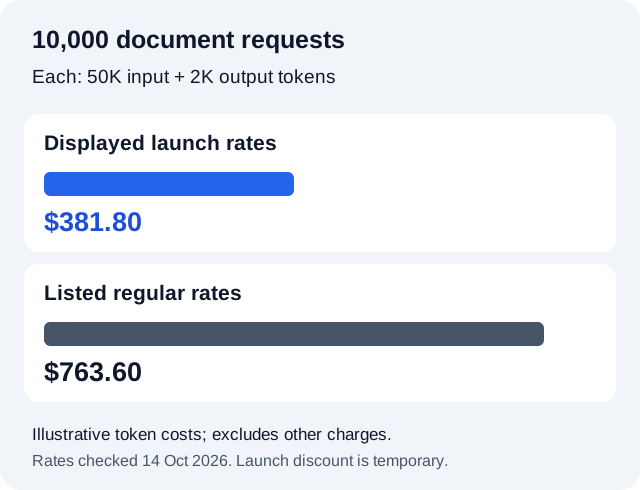
The model card currently displays US-dollar launch rates of $0.68 per million input tokens, $0.07 per million cached input tokens and $2.09 per million output tokens. Its listed regular rates are $1.36, $0.14 and $4.18 respectively. The changelog describes a two-week, 50% launch discount; recheck the live rate card before assuming that discount applies to a later invoice.
Using the standard API price table, each illustrated request costs 50,000 × $0.68 / 1,000,000 for input plus 2,000 × $2.09 / 1,000,000 for output: $0.03818. Multiplying by 10,000 requests gives $381.80. At the listed regular rates, the same calculation produces $0.07636 per request and $763.60 for the batch. These are fixed-token examples excluding cache reuse, tool charges, retries, taxes, storage and application infrastructure.
A production forecast also needs the cost of rejected answers. Measure how often a request is repeated, escalated to another model or repaired by a reviewer. For inference cost and capacity planning, retain both the raw token bill and the cost per accepted task. A lower token rate is useful only when the resulting workflow meets its quality and response-time requirements.
Features that matter when connecting the model to an application
The model card lists the API identifier mistral-large-4, a one-million-token context window, multimodal capability, structured outputs, function calling, document question answering and batch support. Those features describe integration options. They do not establish that an arbitrary long document will be interpreted correctly or that every tool action is appropriate.
For an AI API integration, start with a narrow contract: accepted input formats, required output fields, maximum request size and explicit failure states. Log the model identifier and request configuration with each evaluation result. Avoid silently switching a generic model alias during a trial, because a changed model can make yesterday's baseline difficult to interpret.
Treat errors as part of that contract. Distinguish a provider timeout, a response that cannot be parsed, an unsupported document and an answer with insufficient evidence. Each needs a different recovery path. A timeout may justify a bounded retry; missing evidence may require the user to supply a clearer document. Repeating the same request indefinitely does not resolve a missing source.
A one-million-token window does not replace retrieval design
A larger window can make a long-document experiment possible, but it does not decide which information a particular user may see. Consider an assistant answering a customer question from a shared repository containing several clients' specifications. Loading every document into one prompt would mix permissions, freshness and relevance into a single problem.
Build the authorized evidence set first, then decide how much of it the task needs. Our guide to RAG permissions before vector search explains why the access boundary belongs before retrieval. The same principle applies when context is plentiful: a model's capacity to accept material is not permission to disclose it.
Compare two designs on identical questions: a selected set of relevant passages and a larger document bundle. Score whether the answer cites the correct revision, notices contradictory evidence and admits when the requested detail is absent. Include latency and token usage, but choose the design that meets the evidence requirements. This creates a concrete RAG development evaluation rather than a contest to fill the largest window.
Worked pilot: extract a supplier quote into a reviewable record
An illustrative pilot could take a supplier quotation and prepare a procurement review record. Input would include the quote, its revision date and the related request. Output would contain the supplier name, currency, line items, quantity, unit price, tax treatment and references to supporting passages. Missing or unreadable fields should remain explicitly unresolved.
Mistral's document QnA documentation describes supplying document content for questions about it. Use that capability as the extraction step, then validate the record in application code. Recalculate totals from quantities and unit prices; check the currency against the source; and flag conflicting quote revisions. Do not accept a fluent summary as evidence that the arithmetic is correct.
A useful test example contains two similar product names with different units, an expired quote and a handwritten correction. Ask the system to identify the current price and show where it came from. The correct output may be a request for clarification. Keep that outcome in the evaluation set so the model is not rewarded for always returning a complete-looking record.
Start with read-only extraction into a review queue. Purchase approval and sending an order are separate actions with separate authorization. The application's distinction between read, draft and send permissions should remain visible when the model is connected to operational systems.
Structured output and tool calling need different checks
Mistral's structured-output guide distinguishes JSON mode from a custom output schema and recommends custom structured outputs when possible. For the quote record, define required fields and permitted values deliberately. A field that can legitimately be unknown needs an explicit representation; forcing a non-empty value encourages an apparently valid answer where the source provides none.
Schema validation answers whether the response has the expected shape. Business validation asks whether its values are supported. Test these separately: a syntactically valid record can still contain a wrong currency, an invented supplier identifier or a total taken from an obsolete revision. Keep the evidence reference alongside each extracted value so reviewers can examine the underlying claim.
The function-calling guide describes a flow in which the model proposes function arguments and the developer's application executes the function. Keep authorization and validation at that execution boundary. For a supplier lookup, allow only the necessary lookup operation; an argument generated by the model must not grant itself access to an unrelated account or a purchasing action.
How to interpret the launch's capability claims
Mistral presents Large 4 as a model for coding, scientific and professional knowledge work, with evaluations and demonstrations in its announcement. It also says reinforcement-learning work continues during this preview. These are reasons to investigate relevant tasks, not an independent measurement of performance in your application.
Avoid turning a small successful demo into a general capability claim. A quote extractor that works on clean digital PDFs may fail on low-resolution scans or mixed-language documents. Publish results by document type and error category, with the sample size and model configuration, so a strong overall average cannot hide the cases that need human review.
What existing Mistral work can teach a deployment team
Daphnis's PA: Product & Collection Sort case study describes a Shopify application combining RFM algorithms with a self-hosted MegaBeam-Mistral-7B model. It is a different model and workload; that project is not evidence of a Mistral Large 4 deployment or benchmark.
Its useful connection is the need to fit model behavior into a concrete product. A collection-sorting tool has merchant rules, stock information and purchasing signals to respect. A quote-review tool has document revisions, currency and approval rules. In each case, write down what the application must enforce independently and what the model is being asked to infer. That boundary produces a more useful technical brief than choosing a model by its headline size.
A release decision your team can reproduce
Build a labelled evaluation set from sanitized examples of the intended work. Include ordinary inputs, missing fields, contradictory revisions, unreadable pages and instructions embedded inside documents that should be treated as source text. Reserve some examples for a final check after prompt changes. Agree in advance which failures block release and which can enter a review queue.
Run the same sample through the candidate and current implementation. Retain source references, extracted values, validation failures, token usage, latency, retries and reviewer decisions. Calculate the fraction of tasks accepted without repair, then inspect the reasons behind rejection. Set thresholds according to the consequence of a wrong result, not according to the score the first experiment happened to achieve.
Bring the sample documents, expected records and error breakdown to an AI evaluation and guardrails review. The immediate deliverable should be a decision on a bounded pilot, with a fallback path and a reason to stop or expand it. Re-run the held-out checks when the preview model or integration changes so a later rollout remains tied to evidence.